
How to choose your first business automation workflow
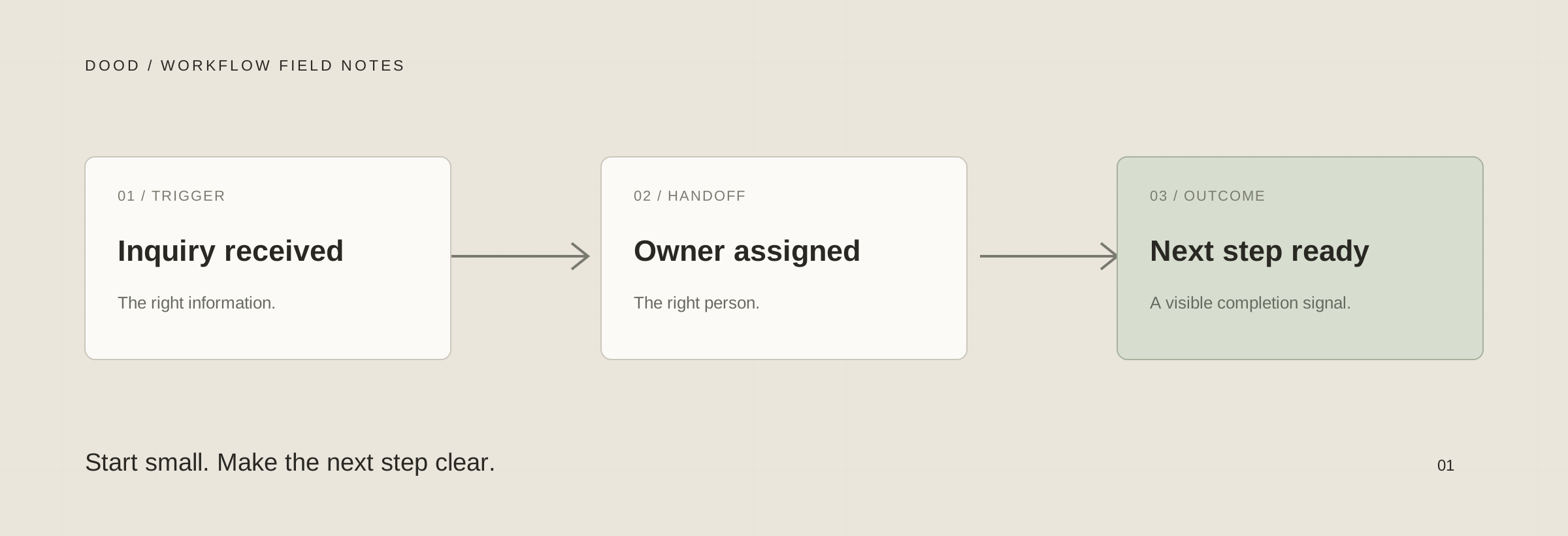
Choose a first automation project with a practical scorecard for repeatable tasks, clear ownership, and measurable outcomes.
On this page
Start with a workflow that happens often, follows clear rules, has a named owner, and is easy to check when something goes wrong. A small process with a measurable outcome makes a better first project than an attempt to automate an entire business at once.
The useful question is not “What can our software automate?” It is “Where does our team repeatedly lose time or context, and what would a better handoff look like?”
Look for repeated handoffs
Write down three recurring processes that frustrate your team. They might be moving a website inquiry into the CRM, requesting missing onboarding documents, or preparing the same weekly report.
For each one, describe:
- What starts the process.
- Which information the person needs.
- What they do with that information.
- Who owns the next step.
- How they know it is complete.
- What happens when the normal path does not apply.
If the team gives different answers, resolve that disagreement before building the automation. Otherwise, the system may reproduce an unclear process more quickly.
Use a simple scorecard
This is a planning aid, not an industry benchmark. Score each candidate from zero to two using the questions below.
| Question | 0 | 1 | 2 |
|---|---|---|---|
| Does it repeat? | Rarely | Sometimes | Often enough to observe a pilot |
| Are the rules clear? | Mostly judgment | A mix | Clear normal path and exceptions |
| Is the input usable? | Inconsistent or inaccessible | Needs some cleanup | Available and structured |
| Is there a process owner? | No owner | Shared responsibility | One accountable owner |
| Can we check the result? | Hard to measure | Partly visible | A clear completion signal |
| Can a person intervene? | No reliable fallback | Fallback needs work | Easy to pause and handle manually |
Compare the scores, then discuss the low-scoring areas. Do not let a high total override a missing owner or an unsafe fallback. Those are reasons to prepare further before launching.
Define a small first version
Consider this hypothetical example: a service business receives inquiries through its website, and someone copies each inquiry into a CRM before assigning it.
A focused first version could:
- Validate the required inquiry fields.
- Check whether the contact already exists.
- Create or update the CRM record.
- Assign it according to an agreed routing rule.
- Notify the assigned person.
- Record any failed handoff for manual follow-up.
That scope does not need to include automated qualification, proposal generation, or every later sales stage. Those can be considered after the team understands how the initial handoff performs.
Duplicate detection and failed assignments deserve attention from the beginning. An automation that works for the normal case but silently drops exceptions can make the process harder to trust.
Establish a baseline before making changes
Observe enough completed examples to understand the current process. Record the start and completion times, manual effort, missing information, and rework.
Choose measurements that match the problem. For a lead handoff, useful measures could include time until an owner is assigned and the number of inquiries that need manual correction. For a reporting workflow, look at preparation effort, data freshness, and reconciliation work.
Keep effort and elapsed time separate. A process can take a day to finish while using only ten minutes of someone's time. Removing a wait is valuable, but it should not automatically be counted as a full day of labor saved.
Plan the exception path
Before the pilot, answer these questions:
- Who receives an alert if a step fails?
- Where can they see what happened?
- Can they retry without creating duplicate records or messages?
- Which situations require a person's judgment?
- How can the team pause the workflow and use the manual process?
Choose access permissions appropriate to the work. A workflow that only creates inquiries should not need unrestricted access to every business record.
Review a pilot before expanding
Run the pilot over enough real workflow cycles to observe both the normal path and expected exceptions. Compare the results with the baseline and ask the team whether the new process made their work clearer.
If the workflow creates extra correction work, fix the rules or inputs before adding more steps. If it behaves reliably and the result is useful, expand one part at a time.
Your first-project checklist
Before implementation, you should be able to write down:
- One workflow and a clear boundary.
- One accountable process owner.
- The trigger, required information, and completion signal.
- The normal path and known exceptions.
- A manual fallback.
- A baseline and a way to assess the pilot.
For help organizing the steps, use Dood System's repeatable-task template library. You can also explore the implementation case studies to see how workflow changes fit into a wider business system.
If you already know where work gets stuck, tell us about the workflow. We can discuss a focused working prototype and what the first implementation should include.