
What to automate in client onboarding—and what to keep human


Automate repeatable onboarding coordination while keeping scope decisions, sensitive exceptions, and acceptance with people.
On this page
Client onboarding automation works best when it coordinates agreed tasks and makes exceptions visible. Use it to create checklists, request known information, and route work. Keep decisions about scope, suitability, and unusual client circumstances with an accountable person.
Draw the boundary before building
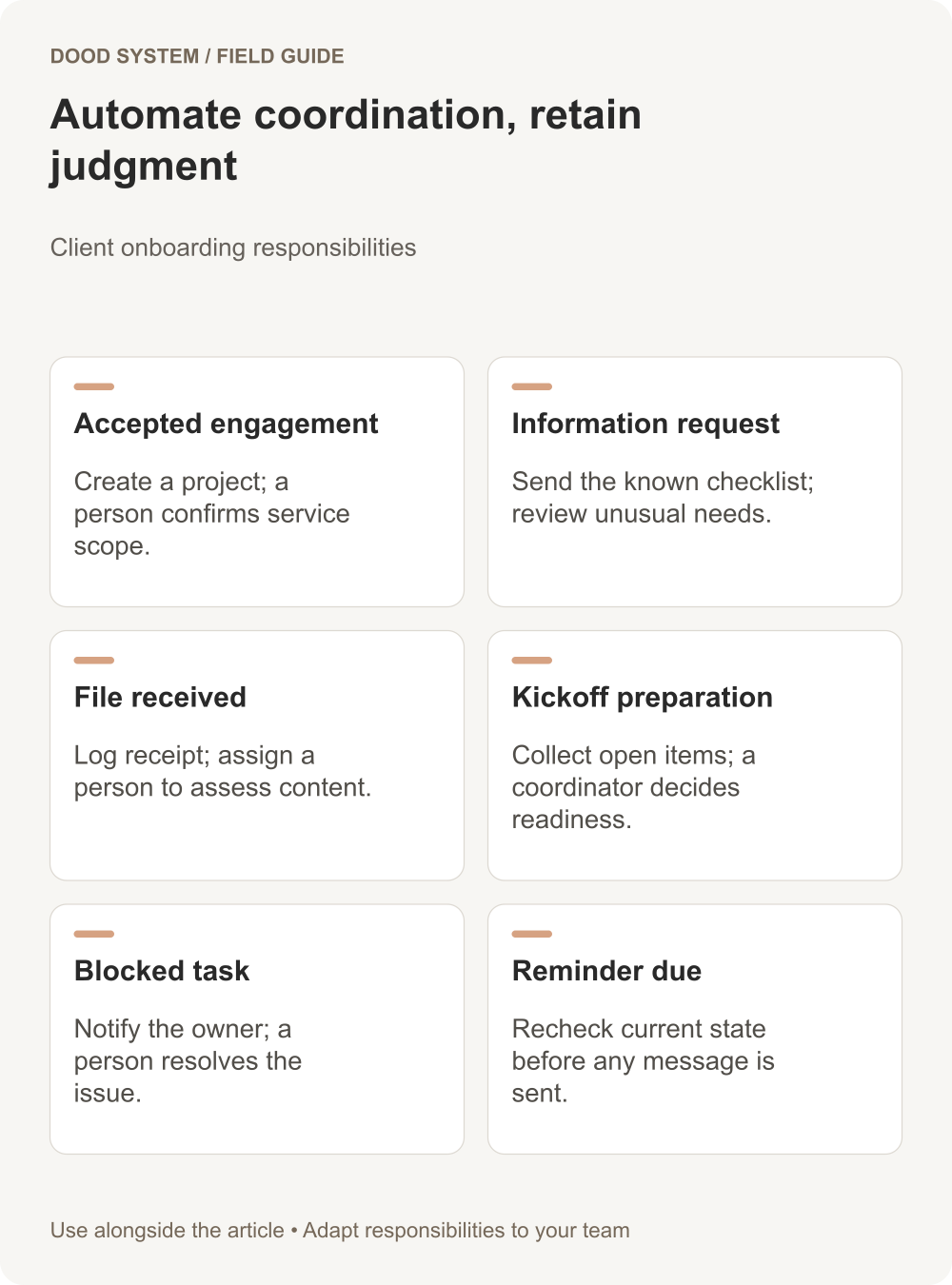
| Onboarding step | Suitable automation | Human responsibility |
|---|---|---|
| Engagement accepted | Create a project from the chosen template | Confirm which service was agreed |
| Information request | Send the applicable checklist | Decide unusual requirements |
| File received | Record receipt and create a review task | Assess the contents |
| Kickoff preparation | Collect open items into a briefing | Decide readiness |
| Blocked task | Notify its owner and track review time | Resolve the blocker |
A workflow should not infer approval from a checked box that merely means received. Name statuses according to the evidence they actually represent.
Build a small task template
For each task, record a responsible role, required input, completion evidence, and dependency. Resolve roles to real people when the engagement starts. If no suitable owner is available, place the task in a visible exception queue.
ERPNext's project templates provide reusable tasks for projects. The template is a starting structure; it still needs to match the engagement and have workable assignments.
Example: kickoff is not ready
Consider a hypothetical onboarding project where the kickoff date is approaching but access to the client's source system is unavailable. Instead of marking all other tasks late, record the access dependency and assign one owner to resolve it.
The coordinator can decide to reschedule, change the kickoff agenda, or proceed with limited discovery. The automation should present the missing input and available context. It should not quietly promise delivery dates that depend on unresolved access.
Prevent repeated and conflicting messages
Before sending a reminder, recheck whether the information has arrived, the engagement is paused, or another team member has already contacted the client. Keep one authoritative task state. A queued message based on yesterday's state can become wrong before it is sent.
Evaluate the first few onboardings
Review time spent coordinating, requests sent twice, work returned for correction, and tasks with no owner. Collect staff feedback on whether the checklist reflects the actual service. Use those observations to improve the template rather than adding automation to every exception immediately.
Our client onboarding pipeline template can help organize the first version. Bring one completed engagement and one difficult exception to a workflow review.