
A lead follow-up workflow that keeps ownership clear


Give every new inquiry a clear owner, next action, stop condition, and exception path before automating follow-up.
On this page
A lead follow-up workflow needs more than a sequence of messages. It needs an owner, a next action, and a reason to stop. Design those rules first so that a reply, booking, or rejection changes what the system does next.
Define the first event precisely
Choose a reliable start event, such as a completed inquiry form that passes basic validation. Store the inquiry time, source, requested service, contact details, and consent or communication preferences captured through the appropriate process. Keep an automated acknowledgement distinct from a personal response in reporting.
Do not restart the sequence every time a contact record is edited. Use an inquiry or engagement identifier so a repeat event can be recognized without creating another follow-up plan.
Use this routing and stop table
| Event | Action | Stop or continue? |
|---|---|---|
| Valid inquiry | Assign owner and create review task | Continue |
| Client replies | Notify the owner and pause timed outreach | Pause |
| Meeting booked | Create meeting preparation task | Stop inquiry reminders |
| Wrong service | Route for clarification or close with a reason | Owner decides |
| Contact asks to stop | Suppress further outreach in this workflow | Stop |
| Message fails | Create an owner task with the failure reason | Do not repeat blindly |
The timing between steps should reflect the service and the client's expectations. Do not copy an arbitrary follow-up frequency from another business and assume it suits yours.
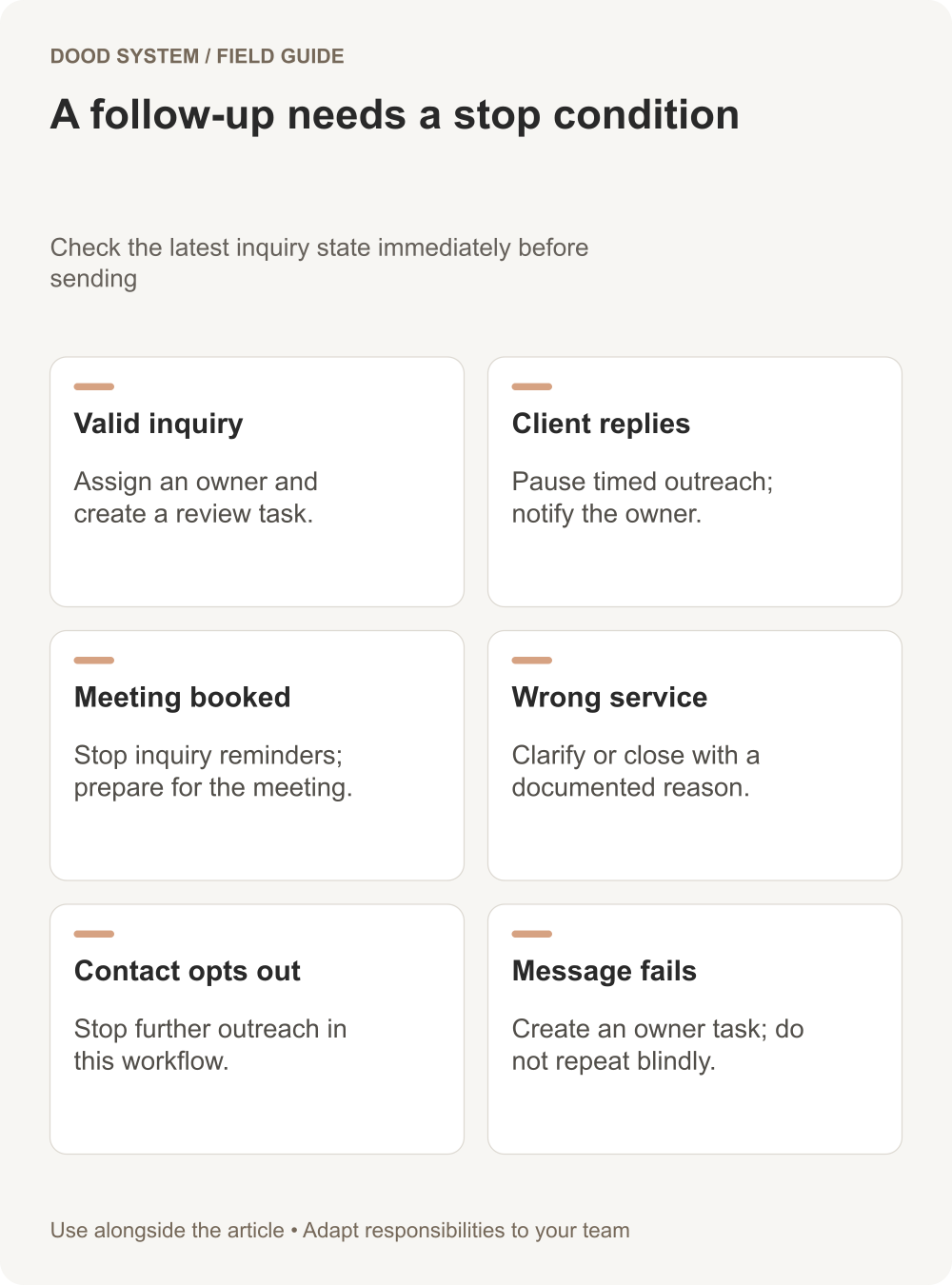
Example: a reply arrives before the next reminder
In a hypothetical workflow, an inquiry receives an acknowledgement and a task for the assigned adviser. A reminder is scheduled for the following business day. The client replies that afternoon with a question.
Before sending the reminder, the workflow checks the current inquiry state. Because a reply has arrived, the reminder is cancelled and the owner receives a response task. The workflow should evaluate this condition at send time, not only when the reminder was first scheduled.
Build an exception queue
Create a view for unassigned inquiries, failed messages, overdue owner tasks, and replies awaiting attention. Include the age of the oldest item. A workflow can appear busy while leaving its difficult cases untouched; the exception queue exposes that gap.
For teams using ERPNext, assignment rules provide configurable assignment methods. Confirm that the selected method also handles your coverage and absence arrangements.
Check performance without confusing events
Measure time to assignment, time to first personal response, and the share of inquiries with a valid next action. Track automated acknowledgements separately. Sample closed records to confirm that reminders actually stopped.
Use our lead follow-up sequence resource to outline your version, then bring one inquiry journey to a prototype discussion.