
CRM pipeline stages: how to define a useful next action


Define CRM stages using observable entry and exit criteria so that each opportunity has a meaningful next action.
On this page
Useful CRM pipeline stages describe progress in a buying decision. They should tell a colleague what has happened, what remains uncertain, and what to do next. Avoid stages that merely describe how busy the salesperson feels.
Write an exit condition for every open stage
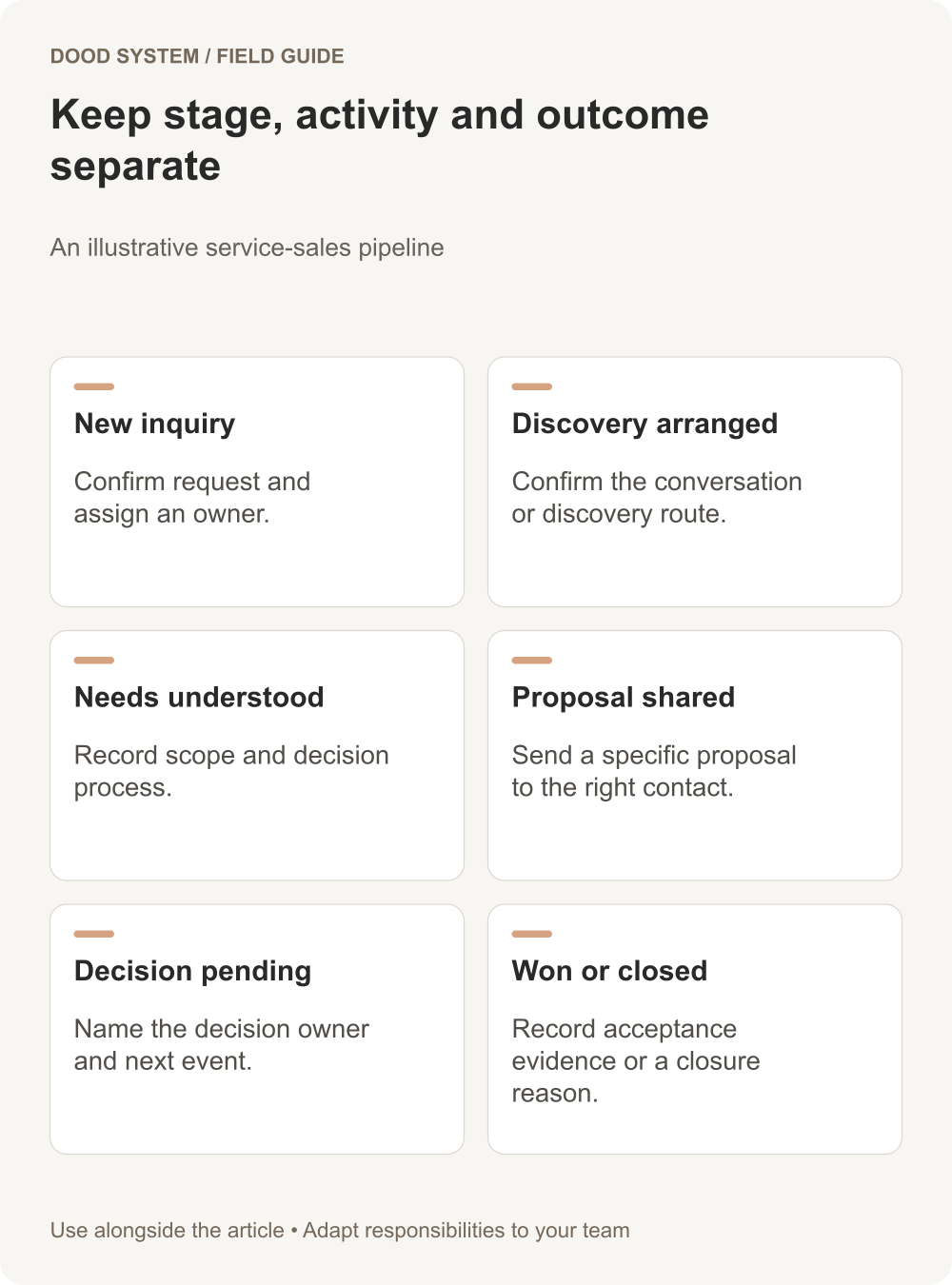
Use this illustrative service-sales pipeline as a starting point, then adapt it to your actual sales process.
| Stage | Evidence required to move forward |
|---|---|
| New inquiry | A responsible owner and a valid request |
| Discovery arranged | A confirmed conversation or agreed discovery route |
| Needs understood | Recorded problem, scope boundaries, and decision process |
| Proposal shared | A specific proposal sent to the right contact |
| Decision pending | A known decision owner and next decision event |
| Won | Your organization's documented acceptance requirement is met |
| Closed without a sale | A reason and any appropriate future action |
Do not define won as an enthusiastic conversation if your operating process requires a signed agreement. Equally, do not force every opportunity through a meeting stage when some customers buy through a different route.
Keep stage, activity, and outcome separate
A stage describes where the opportunity stands. An activity is something someone must do. An outcome records what happened. Sending an email may complete an activity without moving the opportunity to another stage.
Require a next action, action owner, and due date on open opportunities. If there is nothing sensible to do, the owner should decide whether the opportunity belongs in a paused or closed category rather than inventing a task.
Handle opportunities that move backward
In a hypothetical case, a proposal reaches decision pending, then the customer changes its scope. Move the opportunity back to needs understood and record the reason. Preserving movement history is more useful than leaving the deal near completion while the work has restarted.
Also define how to handle a second opportunity from the same company. It may need a separate deal record even when the contacts are shared.
Review stalled work fairly
Stage age can identify records worth inspecting, but it is not proof that the owner has failed. A customer may have a documented procurement window. Review the next event and latest evidence before escalating.
For an implementation example, Odoo documents CRM activities and activity plans. Confirm the behavior in your installed version before adopting a configuration.
Take ten recent opportunities and classify them using your proposed rules. If two people repeatedly choose different stages, revise the definitions. Bring that sample to a CRM workflow discussion before building more automation around the pipeline.