
Tracking missing documents without losing case ownership


Track each required document as an owned item so that replacements, review decisions, and reminders stay consistent.
On this page
A document collection workflow should track requirements, not just files. For each required item, record its status, owner, review result, and next action. This lets a team distinguish an absent document from one that arrived but still needs correction.
Use a requirement register
Create one row per requirement within the client engagement. Include the requirement label, who requested it, who must supply it, the reviewer, current status, and the approved storage reference. Limit access to the roles that need the information.
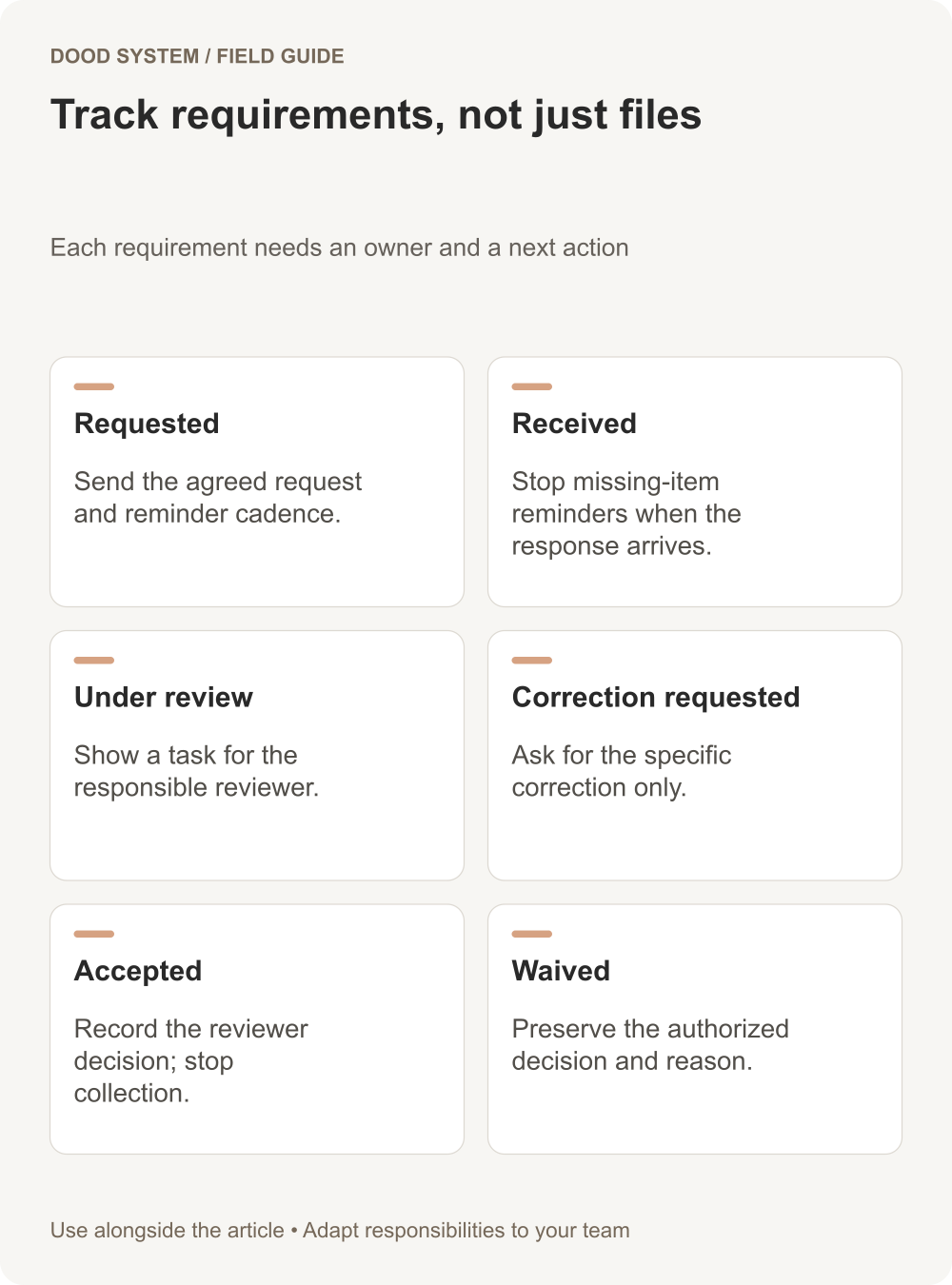
| Status | Meaning | Reminder behavior |
|---|---|---|
| Requested | The requirement has been communicated | Follow the agreed cadence |
| Received | A file or response arrived | Stop missing-item reminders |
| Under review | A reviewer is checking it | Show a reviewer task |
| Correction requested | A specific problem remains | Request the correction only |
| Accepted | The responsible reviewer accepts the item | Stop collection messages |
| Waived | An authorized person removes the requirement | Preserve the decision reason |
For immigration operations, the authorized adviser should define requirements and acceptance. An administrative system should not infer legal sufficiency from a filename or upload event.
Handle replacements explicitly
In a hypothetical engagement, a client replaces a document after a correction request. Keep the earlier version and its review history where your retention policy allows. Associate the new version with the same requirement, then return that item to review.
Do not create a new requirement for every upload. That can leave old reminders running and make the checklist look incomplete even when the client has responded.
Make reminders conditional
Check the current status immediately before sending. Combine several outstanding items into one clear request where practical. Identify the next action and avoid including unnecessary document contents or sensitive information in notification text.
ERPNext's notification documentation describes event- and condition-based messages. Configure conditions around the requirement state, not merely the presence of an attachment.
Give reviewers their own queue
Client reminders cannot solve an internal review backlog. Show received items awaiting review, their age, and the named reviewer. Include correction requests with no follow-up owner. Review that queue separately from the list of files still outstanding from clients.
Test a late upload, replacement file, waived requirement, paused engagement, and reassigned reviewer. Each case should produce one coherent next action.
To put the register into practice, start with our case-ready dashboard template and discuss the document handoff.