
How to build an immigration client intake workflow


Build an intake process with a case owner, clear document states, and a defined handoff to your review team.
On this page
An immigration client intake workflow should make three things clear: who owns the case, what information is still needed, and who can approve the next step. Start with those decisions before choosing a form builder or CRM. This guide covers administrative coordination; qualified advisers should determine case requirements and substantive decisions.
Separate the person, engagement, and checklist
Use a client record for contact details, an engagement record for the specific service, and checklist items for individual requirements. A returning client may have a new engagement. Updating their phone number should not create another person or overwrite an older case history.
Give every engagement its own reference. Attach documents to the relevant engagement and requirement, with access limited to the responsible team. Do not use an email subject line as the only link between a file and a case.
A practical intake board
| State | What it means | Next owner action |
|---|---|---|
| Inquiry received | A request exists; scope is unconfirmed | Assign the intake owner |
| Intake in progress | The client is providing information | Check missing fields |
| Review needed | The submission is ready for a person to examine | Assign the reviewer |
| Changes requested | A specific correction is required | Explain the correction |
| Intake accepted | The responsible reviewer accepts the intake | Start the next agreed workflow |
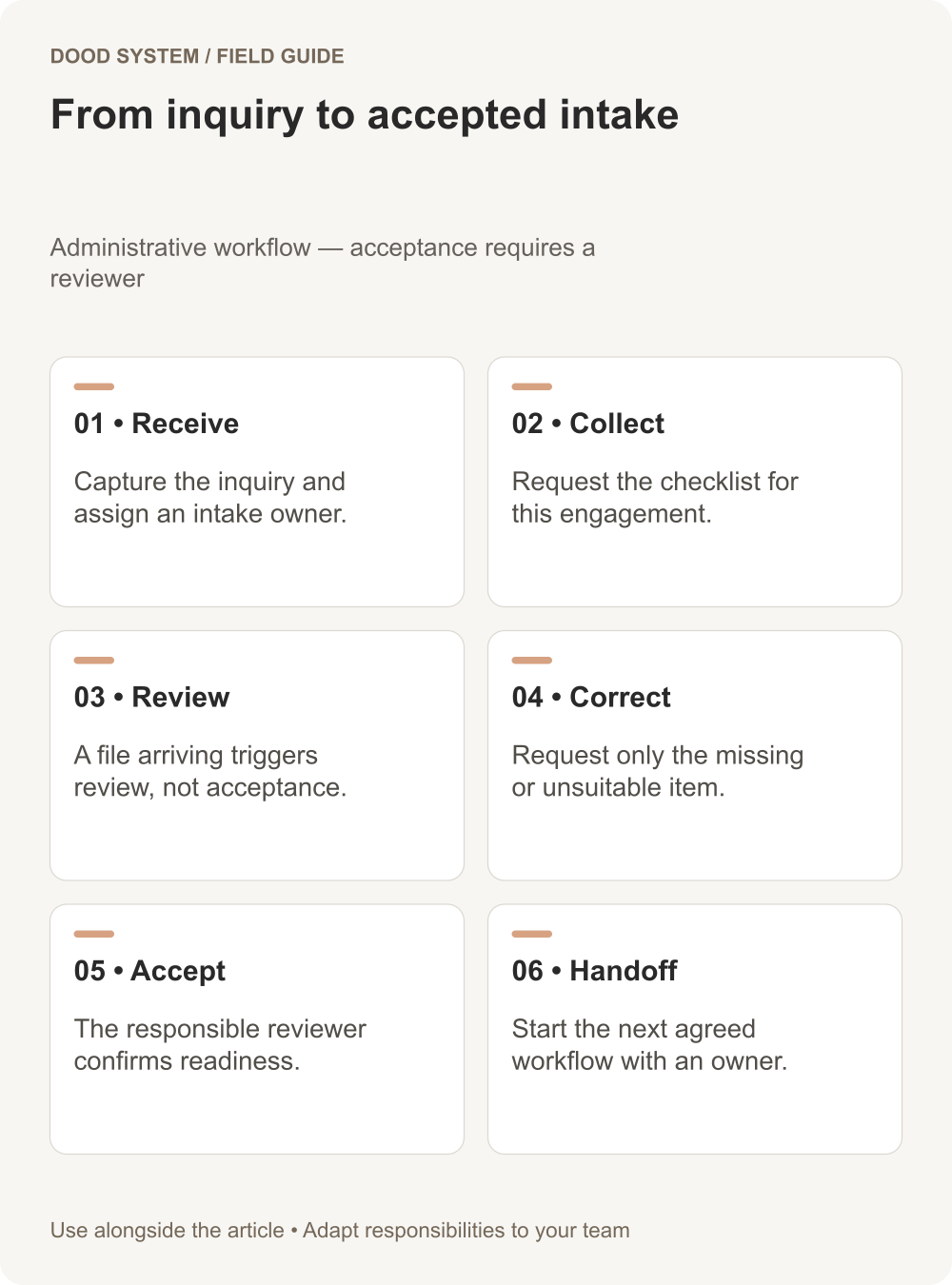
A file upload should move an item to review needed, not directly to accepted. That distinction prevents an automation from treating the presence of a file as proof that its contents are suitable.
Example: a corrected submission
Consider a hypothetical client who uploads an unreadable scan. Keep the original upload history, mark the requirement as changes requested, and send a precise request for a readable replacement. When a replacement arrives, stop the old reminder and create a new review task. Avoid sending the entire checklist again when only one item needs attention.
Record the reason for a return in structured form where possible: unreadable, wrong document, missing page, or clarification required. Add a short explanation when none of those reasons fits.
Test the handoff before launch
Run a sample intake through a missing field, duplicate inquiry, replacement upload, and absent owner. Verify that each path ends with a named person and a visible next action. Also test access using the actual reviewer and client roles, rather than an administrator account alone.
ERPNext offers assignment rules for routing records. Treat routing as one component of the intake design; it does not determine whether a case is acceptable.
Start your own brief with the intake board above and adapt the responsibilities to your team. For the wider process, explore our deadline tracking playbook or discuss an intake prototype.