
One connected platform or several specialist tools?


Compare a connected platform with specialist tools using workflow fit, integration needs, ownership, and transition effort.
On this page
Choose between one connected platform and several specialist tools by testing the work your team must complete. Consolidation is useful when it removes real handoff problems without losing essential capabilities. Keeping a specialist application can be sensible when its depth matters more than the extra connection.
Map the complete job
Write one end-to-end workflow, such as inquiry to proposal to delivery to invoice. Mark where staff re-enter information, reconcile differences, or wait for another team. Then identify which application is authoritative for each record.
A shared login or a large module list does not prove that the workflow is connected. Ask for a demonstration using the same customer and transaction across all required steps.
Use a balanced comparison
| Question | Evidence to request |
|---|---|
| Can the core workflow be completed? | A realistic end-to-end demonstration |
| Does a specialist feature remain necessary? | A test of the actual requirement |
| How do records stay consistent? | Ownership and synchronization rules |
| What happens when a connection fails? | A recoverable failure demonstration |
| Can the business leave later? | An export sample with relationships |
| Who maintains the solution? | Named responsibilities and documentation |
Score a missing essential capability as a blocker, rather than averaging it away with attractive optional features. A high total score can hide a failure in the one process your business cannot do without.
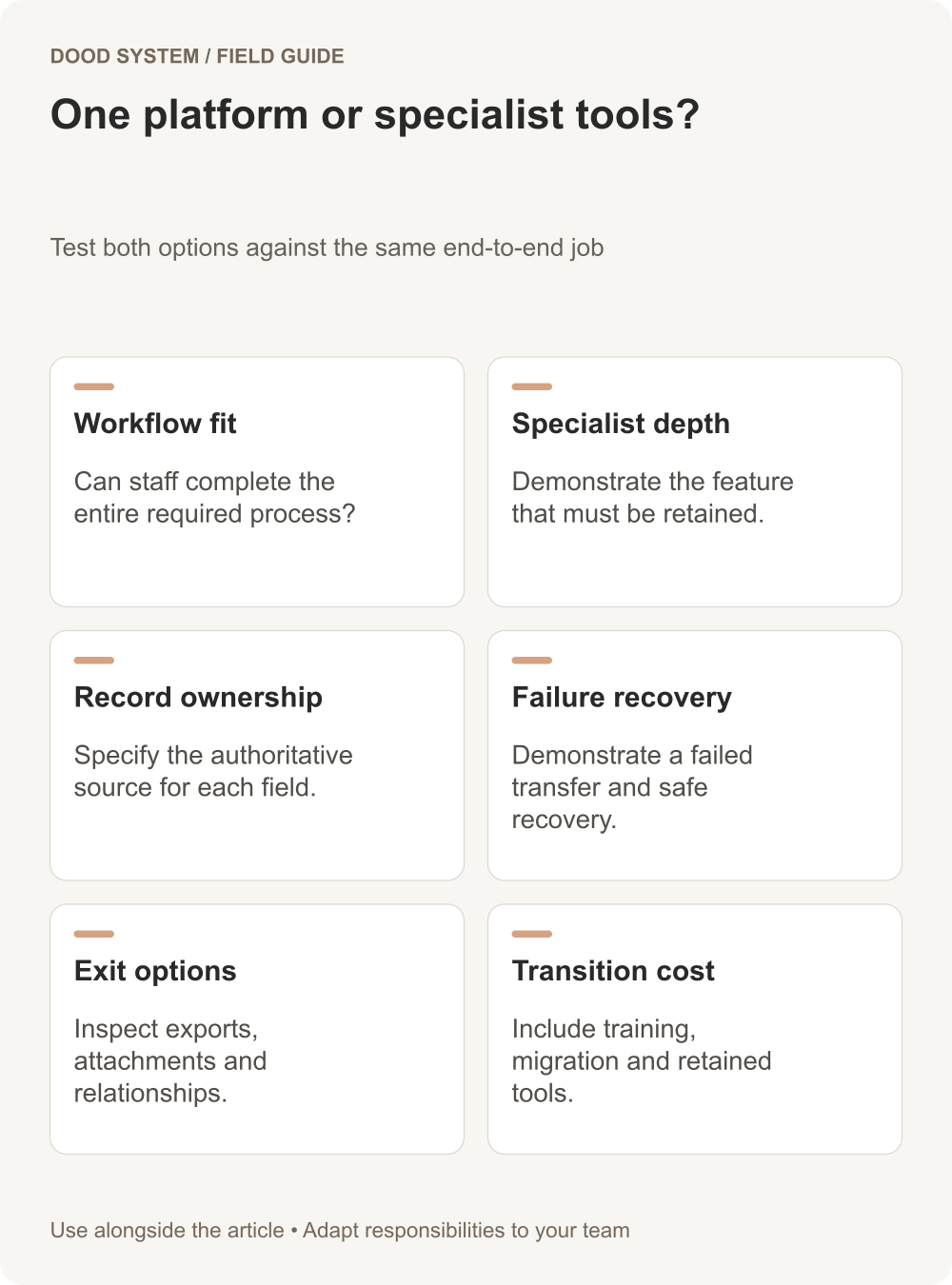
Consider a hybrid arrangement
A hypothetical professional services firm may keep a specialist scheduling application while moving customer records and delivery tracking into a shared platform. In that arrangement, booking identifiers, cancellation events, and customer matching become critical integration requirements.
Compare this with replacing the scheduling tool. The replacement needs to demonstrate the same required scheduling behavior, while the hybrid needs to demonstrate dependable synchronization. Neither option wins automatically.
Account for the transition
Record migration work, staff retraining, report changes, subscription overlap, and the support model. Separate recurring savings from the first-year cost. If a tool will remain for one department, keep its cost in both scenarios where relevant.
Frappe's ERP implementation guidance is useful background for matching an ERP project to business needs. The decision table here is an original planning aid, not a product endorsement.
Before making the choice, ask the people who perform the work to test both approaches on the same sample. Use the software comparison section for cost exploration and request a focused prototype for the workflow decision.