
ERP implementation costs: questions to ask before a quote


Use a scope checklist to compare ERP implementation quotes and uncover exclusions before choosing a delivery partner.
On this page
ERP implementation costs are easier to compare when each quote describes the same work. Before asking for a total, specify the workflows, data, integrations, responsibilities, and acceptance tests that the project includes. An unexplained difference between two prices may be a difference in scope.
Ask for deliverables rather than broad labels
A line called configuration could include anything from creating a company record to designing an approval process. Ask the provider to list the resulting behaviors and the evidence used to accept them.
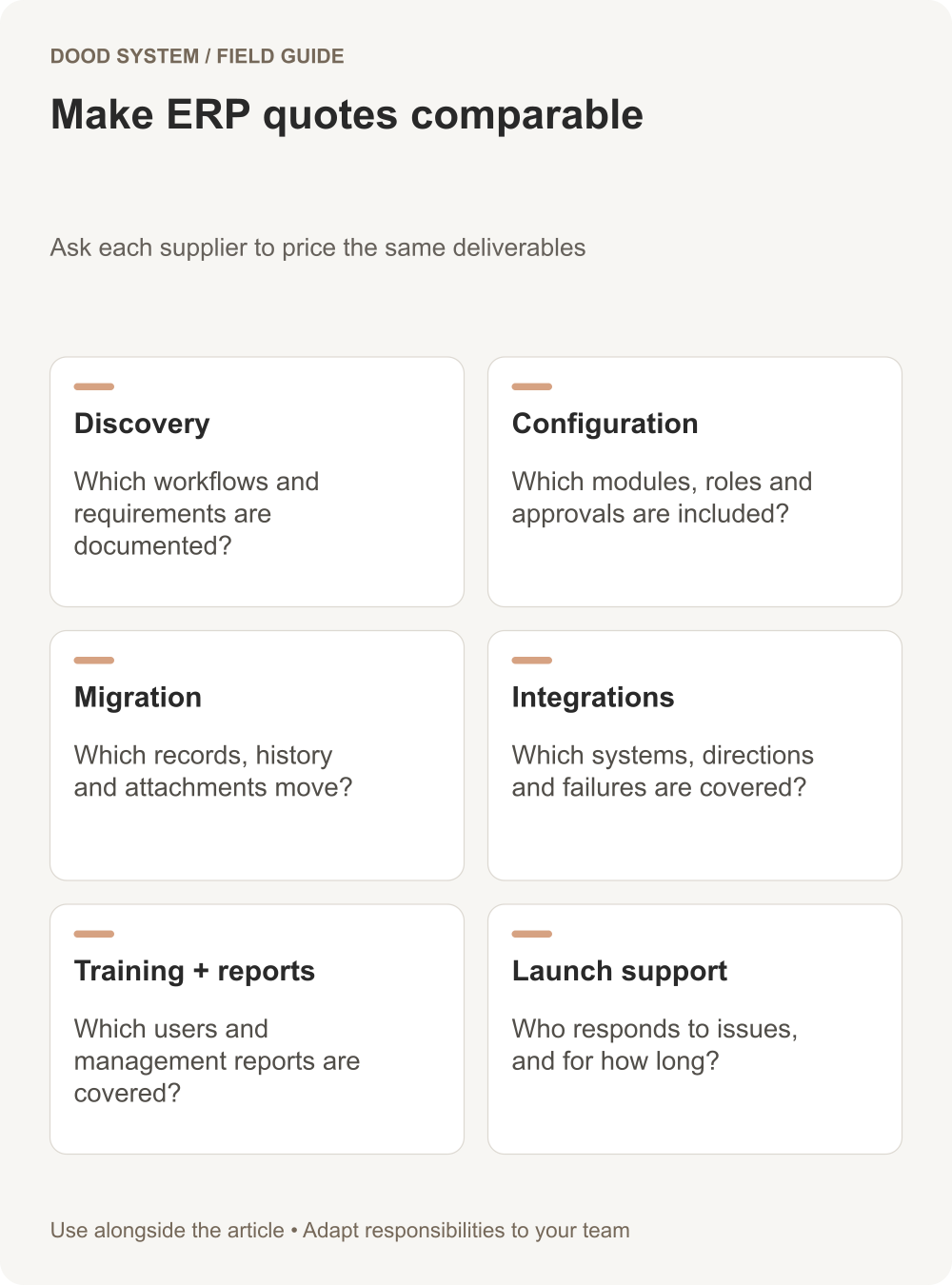
| Quote area | Question to resolve |
|---|---|
| Discovery | Which workflows and requirements will be documented? |
| Configuration | Which modules, roles, fields, and approvals are included? |
| Data migration | Which records, history periods, and attachments will move? |
| Integrations | Which systems, directions, and failure cases are covered? |
| Reporting | Which reports and reconciliations will be delivered? |
| Training | Which roles receive training, materials, and practice? |
| Launch support | Who responds to issues and for how long? |
Separate standard setup, custom development, and third-party work. Each creates different dependencies and maintenance questions.
Clarify the client's responsibilities
The implementation team may require your staff to clean records, decide naming conventions, supply sample transactions, and approve workflows. Those tasks consume time even if the supplier does not charge for them.
Write an owner and due date beside every customer dependency. Ask what happens if the data arrives late or a decision changes after configuration begins. A clear change process makes the cost discussion more concrete.
Compare an example exclusion
Suppose two hypothetical proposals both include customer migration. One includes active customer names and addresses. The other includes contact relationships, attachments, duplicate review, historical transactions, and a reconciliation report.
These are different deliverables. Request a sample mapping and an acceptance checklist before treating either price as better value. Do the same for integrations: a successful sample transfer does not establish recovery from a failed transfer.
Define acceptance and post-launch ownership
Agree which business users will test each workflow. State what counts as a blocking defect, who decides readiness, and who handles support after the initial period. Ask how custom work is documented and how future upgrades will be assessed.
Frappe's ERP implementation guide provides background on planning an implementation. Use the table above as a procurement worksheet rather than treating a generic market price as a quote for your business.
A productive next step is to bring one complete workflow and a representative data sample to a scoped ERP discussion. That gives the estimate an observable basis.