
How to calculate the full cost of your business software


Compare software costs using one time period, actual seat counts, implementation effort, and the tools you still need.
On this page
To calculate the full cost of business software, add recurring fees, usage charges, implementation, migration, training, and the tools you must retain. Compare alternatives over the same period and with the same required capabilities. A low headline subscription can still leave a larger first-year bill.
Build a cost register from actual bills
For each application, record the owner, billing currency, renewal date, paid users, required add-ons, usage units, and cancellation terms. Separate committed spend from optional future spend. If a bill covers several teams, record the total once and allocate it separately; otherwise, the company total may be counted twice.
Use a consistent reporting currency and record the conversion date and source if you convert a foreign-currency invoice. Keep tax treatment consistent across options. The illustration below excludes taxes and currency conversion entirely.
A worked first-year comparison
These are hypothetical US-dollar amounts, not vendor quotes.
| Cost | Current tools | Proposed platform |
|---|---|---|
| Core subscription per year | $7,200 | $4,800 |
| Retained specialist tool | $1,200 | $1,200 |
| Implementation | $0 | $3,000 |
| Training time allowance | $0 | $600 |
| One month of subscription overlap | $0 | $600 |
| First-year total | $8,400 | $10,200 |
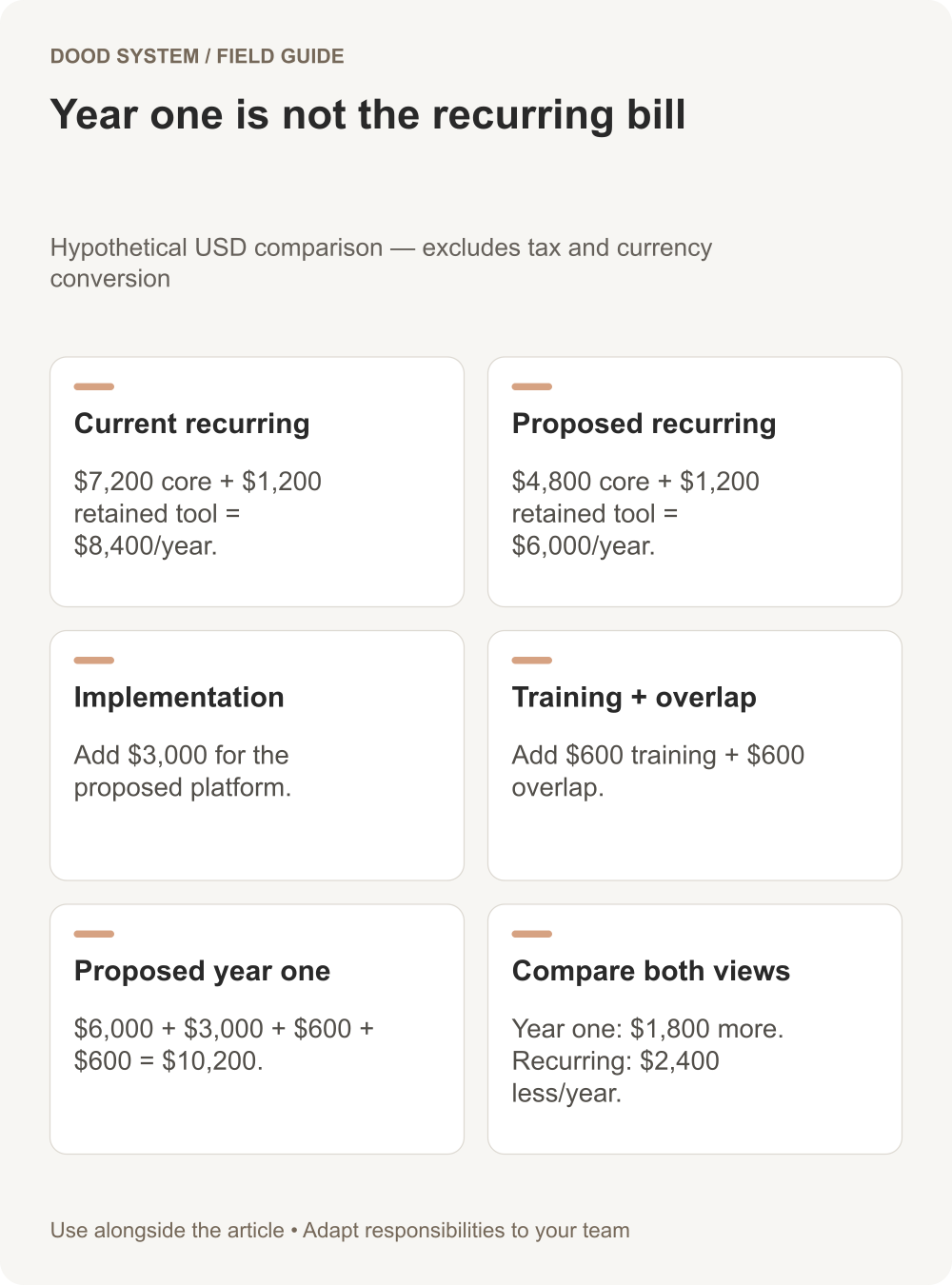
The proposed arrangement costs $1,800 more in year one. Its illustrated recurring total is $6,000 per year, $2,400 below the current arrangement, before future support, price changes, or usage differences. Those are separate findings. Calling the recurring difference a first-year saving would be misleading.
Add the costs a quote may omit
Ask who will clean source data, configure permissions, rebuild reports, test integrations, and train new starters. Assign an amount or mark the line as unknown. An unknown is a question to resolve, not a zero.
Include the effort needed to leave the old system. Check whether exports contain attachments and relationships, whether historical records remain accessible, and whether an annual contract creates a period of unavoidable overlap.
Run three scenarios
Calculate the bill at today's user count, expected growth, and a slower-growth case. If the decision changes between scenarios, identify the assumption responsible. This makes the discussion more useful than choosing the option with the smallest number in one optimistic spreadsheet.
A cost comparison should sit alongside a requirements review. Frappe's implementation guide is useful background on planning a system around business needs; the calculations here are our own illustrative worksheet.
Use the website's software comparison section as a starting point, then add migration and transition costs before requesting a scoped implementation estimate.